地球
Meaning in EnglishEarth, planet Earth
Animated kanji stroke order
Word context
What it means
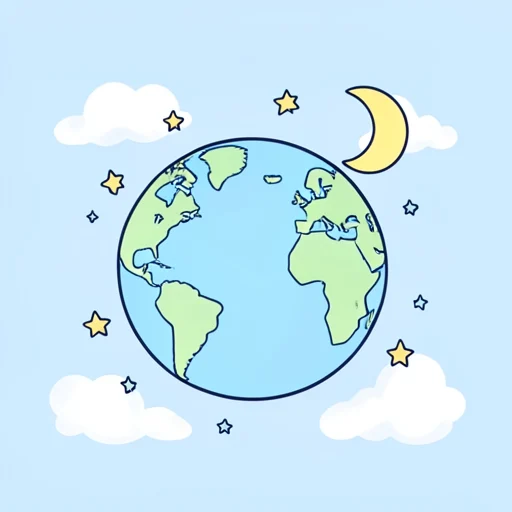
It means the planet Earth: the spherical astronomical body that supports life and is the home of human societies; the term refers to Earth as a physical object in space and as the global system (environment, atmosphere, biosphere) discussed in science, geography and everyday speech.
Main meanings
- the physical globe or model representing Earth used in education or display
- the Earth seen as a global system or scale, often in phrases about worldwide phenomena
- a technical term in astronomy and geology distinguishing Earth from other planets
- a figurative sense referring to the human world or global society
How to use it
Used across registers from casual conversation to formal writing: common in news and everyday talk when referring to Earth or global issues, in scientific and educational contexts for astronomy, geology and environmental science, and as a base in compound technical terms indicating global scale.
Variants and close terms
- 世界 (sekai) — world, the human or cultural world
- 地球儀 (chikyuugi) — physical globe, terrestrial globe
- 地表 (chihyō) — Earth's surface
- 宇宙 (uchuu) — space, universe (related concept)
Composition
- 地 (chi) — ground, earth, land (the basic notion of 'ground' or 'soil')
- 球 (kyuu) — sphere, ball (a round object)
Origin
The compound entered Japanese through Sino-Japanese vocabulary and became standard in modern scientific and educational usage during the late 19th century when Western astronomy and translations introduced modern planetary terms into Japanese; it replaced older cosmological expressions in technical contexts.
Word class
noun (名詞)