怪獣
Meaning in Englishmonster
Animated kanji stroke order
Related sentences
Related sentences
There are no published items in this section yet.
Word context
What it means
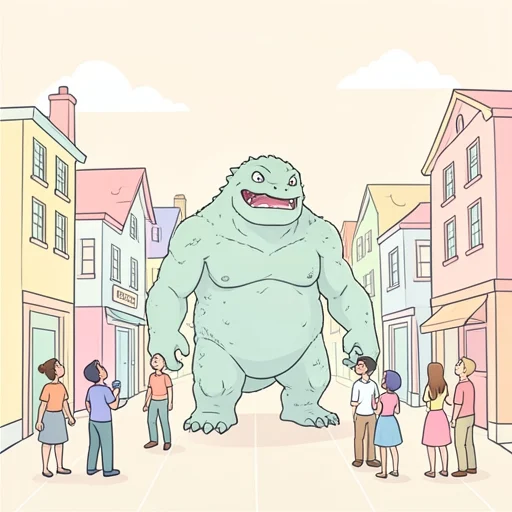
What does 怪獣 mean? It refers to a large or unusual creature—commonly translated as “monster” or “kaiju”—used to denote fictional beasts that are imposing, often supernatural or destructive, and frequently appear as central figures in Japanese entertainment and storytelling.
Main meanings
- Refers to the specific type of large, often spectacular monster featured in fiction and visual media.
- Serves as shorthand for works or elements belonging to the kaiju genre (stories centered on such monsters) rather than a generic animal.
- Used colloquially and hyperbolically to describe anything unusually huge, powerful, or disruptive in everyday speech or headlines.
How to use it
Used across media criticism, marketing, fandom, journalism and casual speech to label creatures, genre works, toys and themed events; in formal writing it appears in academic or historical discussions of film and culture, while in everyday conversation it can be a playful or hyperbolic label for very large animals, machines, or problems.
Variants and close terms
- 怪物 (kaibutsu) — monster
- モンスター (monsutaa) — monster (loanword)
- 妖怪 (youkai) — supernatural apparition, spirit-like creature
- 獣 (kemono) — beast, animal
- 人間 (ningen) — human (antonym used for contrast)
Composition
- 怪: conveys strangeness, mystery, suspicion.
- 獣: means beast or animal, often implying a wild or nonhuman creature.
- The two characters together literally suggest a 'mysterious beast,' which is how the compound expresses the idea of a monster or strange animal.
Etymology
怪 read (kai) and 獣 read (juu) use Sino-Japanese (on'yomi) pronunciations; the compound's modern pronunciation (kaijuu) follows regular on'yomi combination patterns and long-vowel development in Japanese phonology.
Origin
The cultural prominence of the concept rose in the 20th century, particularly after postwar cinematic and special-effects films and television series popularized giant-monster storytelling; the mid-1900s tokusatsu and 'kaiju eiga' boom cemented the term in modern Japanese popular culture and international fandom.
Word class
noun (名詞, meishi)