Word
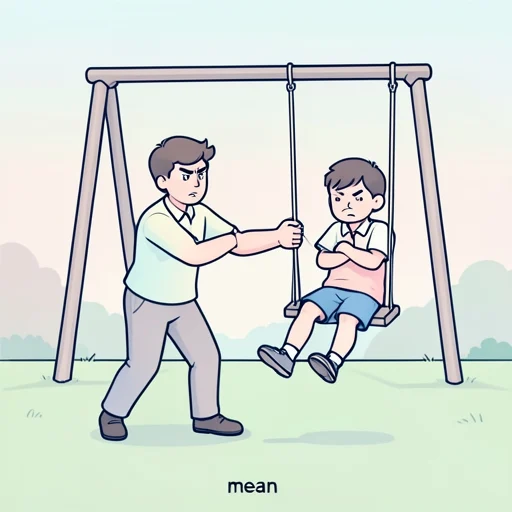
意地悪
Meaning in Englishmean, malicious, unkind
Animated kanji stroke order
Sentence
Related sentences
Related sentences
There are no published items in this section yet.
Word context
What it means
意地悪 means 'spiteful' or 'mean-spirited.' It describes a person who intentionally treats others badly to hurt or upset them, driven by petty malice rather than anger or misunderstanding.
Main meanings
- primary sense: describing intentional cruelty or unkind behavior toward others, often over small matters
- usage with nouns or phrases: 意地悪な人, 意地悪な言動, 意地悪をする; used for both people and actions
- register: common in everyday speech; can be pejorative but not the strongest insult
How to use it
Used in casual to semi-formal speech to describe a person or behavior that is intentionally cruel or petty. Common patterns include 意地悪だ, 意地悪な人, 意地悪な言動; often used to describe explicit intention to hurt, mock, or embarrass someone.
Variants and close terms
- いじわる (ijiwaru) — synonym: same meaning, commonly used in speech
- ひどい (hidoi) — stronger sense of cruelty
- 思いやりがある / 優しい (omoiyari ga aru / yasashii) — antonym
Composition
- 意地: temper, stubborn will
- 地: ground/earth; here contributing to the sense of a trait
- 悪: bad
Etymology
Native compound formed from 意地 meaning will or temper and 悪 meaning bad; pronunciation ijiwaru arises from the standard kun readings joined in a common formation, with no external loanword influence.
Word class
adjective (na-adjective, 形容動詞)
Word
Related words by kanji and components
N1
意気込む
ikigomu
to be enthusiastic about
N1
意向
ikou
intention, idea, inclination
N1
植民地
shokuminchi
colony
N1
地形
chikei
landform, geographical features, topography
N1
悪者
warumono
bad fellow, rascal
N1
地主
jinushi
landlord
N1
地元
jimoto
local
N1
不意
fui
sudden, abrupt, unexpected
N1
墓地
bochi
cemetery, graveyard
Kanji