戦争
Meaning in Englishwar, armed conflict
Animated kanji stroke order
Related sentences
Related sentences
There are no published items in this section yet.
Word context
What it means
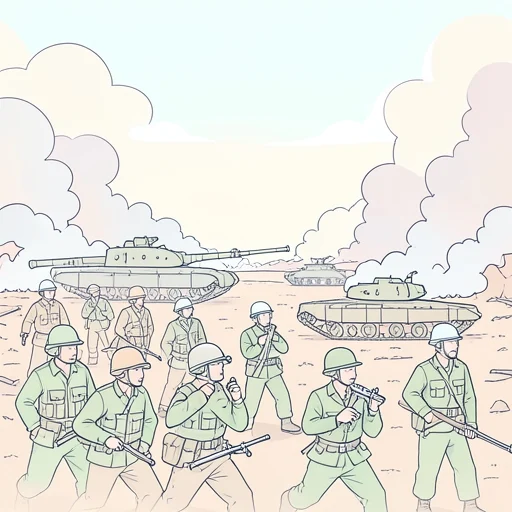
What does 戦争 mean? 戦争 (sensou) denotes a sustained, organized armed conflict between political entities or groups, characterized by military operations, large-scale violence, and political objectives; in everyday English it corresponds to 'war' or 'armed conflict' and covers both declared interstate wars and large civil wars.
Main meanings
- Military engagements at the national or international level as reported in news and history.
- Extended hostilities that involve mobilization of forces, not just a single battle.
- Figurative use to describe intense non-military struggles (e.g., a policy 'war' or 'war on' a social problem).
- Legal/technical sense distinguishing between states of peace and state of war in treaties and international law.
How to use it
Used across formal and informal registers: in news reporting, academic history, legal texts, political debate, and everyday speech when referring to actual wars or metaphorical 'wars' on issues; neutral in tone when reporting facts, more charged when used rhetorically or emotionally; appears in compound terms and set phrases in media and education.
Variants and close terms
- 戦い (たたかい, tatakai) — fight, battle (smaller-scale or individual combat)
- 紛争 (ふんそう, funsou) — dispute, conflict (often diplomatic or civil, less intense than full-scale war)
- 平和 (へいわ, heiwa) — peace (antonym)
- 内戦 (ないせん, naisen) — civil war (specific subtype)
Composition
- 戦 (sen) — battle, fight; conveys warfare, combat actions.
- 争 (sō) — contend, dispute, strive; indicates conflict or competition.
- Together the characters frame the idea of organized armed contention between parties, combining the notions of battle and sustained dispute.
Etymology
戦争 (sensou) uses Sino-Japanese (on'yomi) readings borrowed from classical Chinese pronunciations; the two-character compound was read in Japanese using the imported Chinese phonetics that evolved into modern sen + sō, producing the contemporary pronunciation.
Origin
The modern term gained prominence during Japan's late 19th-century modernization as the nation engaged in large-scale international conflicts (notably the Sino-Japanese and Russo-Japanese wars), when a standardized vocabulary for modern, state-level warfare entered newspaper reporting, diplomacy, and legal discourse.
Word class
noun (名詞)