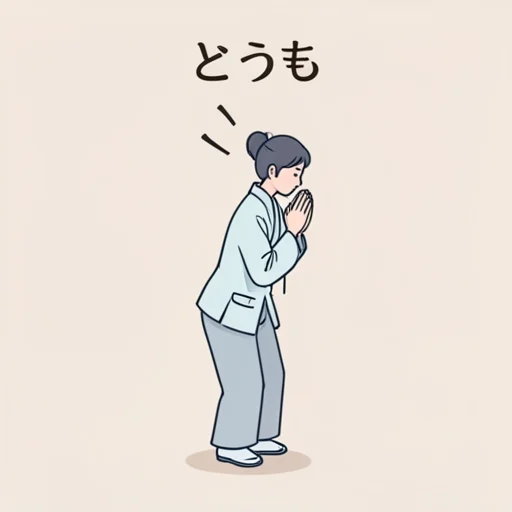
どうも
Meaning in Englishthanks, somehow, very
Related sentences
Related sentences
There are no published items in this section yet.
Word context
What it means
どうも (doumo) is a compact, highly flexible Japanese interjection and adverb that serves as a short, context-dependent conversational signal to acknowledge someone, add emphasis, or express a vague attitude without detailed phrasing.
Main meanings
- 1. A concise expression of gratitude used alone or before a bow, functioning as an informal 'thanks'.
- 2. An intensifier meaning 'very' or 'extremely' when placed before adjectives or adverbs.
- 3. A softening marker in apologies or regrets, adding politeness without a long explanation.
- 4. A filler indicating vagueness or uncertainty equivalent to 'somehow' or 'for some reason'.
- 5. A casual greeting or attention-getter in passing interactions, similar to 'hi' or 'cheers' in some contexts.
How to use it
Common in casual and semi-formal speech, used alone as a short thank-you in shops or between acquaintances, prefixed to adjectives for emphasis in spoken sentences, inserted in apologies to soften tone, and deployed as a quick greeting or attention-getter in passing; register depends on intonation and additional words (it is less common as a standalone full-form phrase in very formal contexts).
Variants and close terms
- ありがとう (arigatou) — thank you (more explicit gratitude)
- どうか (douka) — please / somehow (different function but related form)
- まことに (makoto ni) — very; truly (formal intensifier)
- どうもね (doumo ne) — regional/informal ending adding familiarity
Etymology
どうも (doumo) developed from the combination of the adverb dou ('how') and the particle mo ('also/ever'), with phonetic contraction and pragmatic bleaching over time turning a literal phrase into a multifunctional interjection and adverb.
Origin
Usage is attested in premodern Japanese and became widespread as a conversational filler and politeness shortcut during the Edo to Meiji transition; urban speech and commerce accelerated its adoption as a compact social marker in everyday interactions.
Word class
interjection and adverb (感動詞・副詞)