家
Meaning in Englishhouse / home
Animated kanji stroke order
Related sentences
Word context
What it means
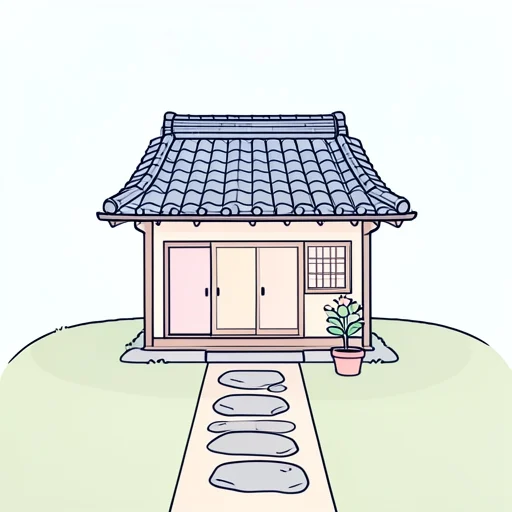
What does 家 (ie) mean? It denotes a physical dwelling (a place where people live) and, by extension, the idea of 'home'—a center of daily life and belonging—and can also refer to the household or family as a social unit.
Main meanings
- 1. As a suffix 家 (...ka) indicating a professional or specialist in a field.
- 2. The colloquial sense expressed by うち (uchi) when speakers use it to mean their home, household, or even as a personal pronoun in casual speech.
- 3. A dynastic or family-line sense: the “house of” someone, used in names to indicate lineage or an established family.
- 4. Appears in compounds to categorize types of dwellings, residences, or institutions related to living spaces.
How to use it
Used as a common noun in everyday speech to refer to a house or home, in formal writing for addresses and legal/household contexts, as a suffix to denote specialists in names of professions, and colloquially (as うち (uchi)) to mean 'my home' or 'I' in casual, regional, or gendered speech patterns.
Variants and close terms
- 家庭 (katei) — household, family life
- 住宅 (juutaku) — dwelling, residential housing
- 家族 (kazoku) — family (individual members)
- うち (uchi) — informal home/‘I’ (regional/pronoun usage)
Composition
The kanji splits into a roof component and a pictograph of an animal beneath: the roof radical 宀 (ukanmuri) placed over 豕 (buta), historically suggesting a dwelling that shelters domestic animals and people, which conveys the basic idea of a house.
Etymology
家 (ie/ka) carries both native Japanese (kun) reading ie and Sino-Japanese (on) readings ka/ke; the on readings derive from Middle Chinese pronunciations adopted into Japanese when kanji were borrowed, while the kun reading records the existing Japanese word for a dwelling.
Origin
The human concept of a permanent house developed in Japan across prehistoric to early historic periods (Jōmon to Yayoi) as communities settled; the written character 家 (ie) was adopted later with the introduction of Chinese writing and came to represent both the physical home and the household unit in legal, literary, and social contexts.
Word class
noun (名詞), kanji (漢字)