寺院
Meaning in Englishtemple
Animated kanji stroke order
Related sentences
Related sentences
There are no published items in this section yet.
Word context
What it means
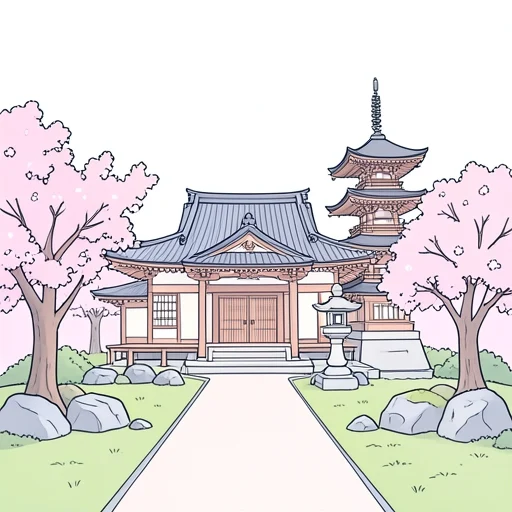
寺院 (jiin) means 'temple' — a term referring to a Buddhist temple or monastic establishment in Japan, understood as the physical buildings and institutional entity where Buddhist clergy live, study, and perform religious activities; it denotes the organized place of Buddhist practice rather than a casual or colloquial mention of a single temple building.
Main meanings
- As an administrative label: used to refer to the legal or organizational entity that manages temple property and clergy.
- In historical and archaeological texts: denotes an identified temple site or former temple institution under study.
- Literary/metaphorical use: sometimes used to evoke the idea of a sacred or secluded institution rather than a literal building.
- In compound terms: appears as part of longer words naming temple-affiliated institutions or facilities.
How to use it
Commonly found in written and formal contexts such as maps, guidebooks, academic writing, official documents, temple registers and news reports; in everyday conversation speakers more often say 寺 (tera) or お寺 (otera) for a casual reference, while 寺院 (jiin) appears when the speaker or writer intends a more formal, institutional or historical nuance.
Variants and close terms
- 寺 (tera) — temple (casual, common spoken word)
- お寺 (otera) — polite/casual temple
- 僧院 (sōin) — monastery (emphasizes monastic community)
- 神社 (jinja) — shrine (Shinto site; not the same, often contrasted)
Composition
- 寺 (tera, ji) — 'temple'; a character denoting a Buddhist temple or monastery.
- 院 (in) — 'institution', 'court', or 'facility'; used in compounds to indicate an organized establishment.
- Together they form a compound meaning an institutional temple or temple complex — literally 'temple' + 'institution'.
Origin
The concept of organized Buddhist temples entered Japan with Buddhism from the Korean Peninsula and China in the 6th–7th centuries; by the Nara (8th century) and Heian periods the state sponsored temple systems and large monastery-temple complexes were established, and the term came to denote both the religious buildings and their institutional roles within Japanese society.
Word class
noun (名詞)