崩壊
Meaning in Englishcollapse, decay (physics), crumbling
Animated kanji stroke order
Related sentences
Related sentences
There are no published items in this section yet.
Word context
What it means
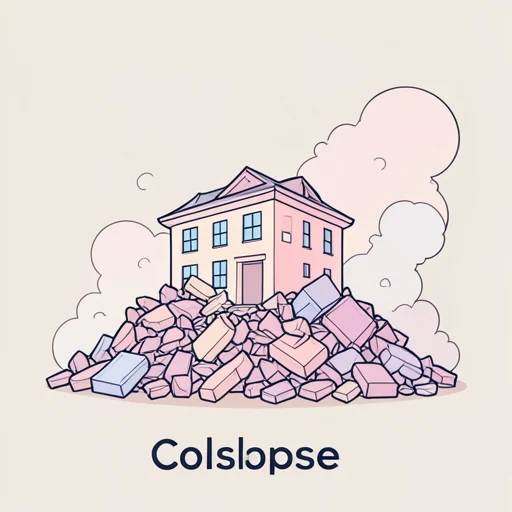
崩壊 means a total collapse of structure, system, or order. It denotes a rapid, often almost complete failure, whether physically (a building), socially (an institution), or conceptually (a plan or regime) and is used in formal and critical discourse to describe dramatic ruin.
Main meanings
- Physical collapse of a structure or landscape, such as a building, dam, or cliff.
- Systemic or institutional breakdown, including governments, economies, or organizations.
- Figurative ruin of plans, projects, or morale, implying rapid, irreversible decline.
- Narrative or historical usage to denote catastrophic disruption or end of a period.
How to use it
Primarily a formal term for a complete or systemic collapse; occurs with the verb form 崩壊する to describe ongoing or completed collapse; common in academic papers, news reports, and literary works; casual speech favors 崩れる for general 'to collapse' in everyday contexts.
Variants and close terms
- 崩落 (houraku) – collapse of a cliff or structure; romaji: houraku
- 破綻 (hatan) – breakdown or bankruptcy of a system; romaji: hatan
- 滅亡 (metsubou) – downfall or extinction of a state or civilization; romaji: metsubou
Composition
- 崩: to crumble, fall apart; conveys sudden loss of integrity
- 壊: to break, destroy; emphasizes ruin and damage
Etymology
崩 (hou, ほう) meaning collapse, crumble; 壊 (kai, かい) meaning destroy, ruin; combined, the compound expresses a thorough breakdown; the reading houkai developed as a standard noun in Japanese.
Origin
Used in classical and modern Japanese, originally describing physical ruin and later extended to abstract domains like institutions and societies; in contemporary writing it appears across journalism, academia, and fiction to signal comprehensive ruin.
Word class
Noun; used as 崩壊 or in the verb phrase 崩壊する (to collapse) (名詞, 動詞・サ変接続).