戸
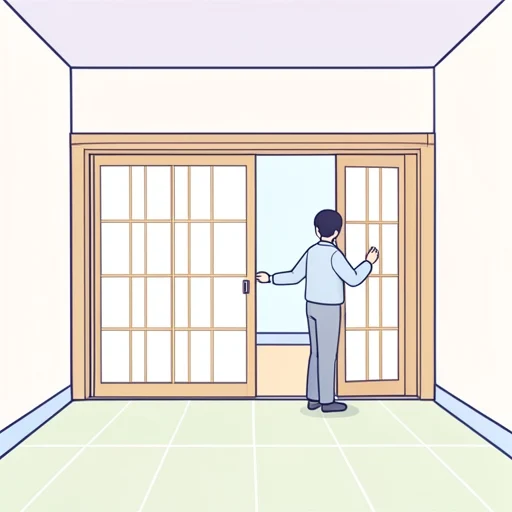
Meaning in Englishdoor (Japanese style)
Animated kanji stroke order
Related sentences
Related sentences
There are no published items in this section yet.
Word context
What it means
戸 (to) means a single domestic unit or the physical barrier used to close a dwelling; it refers both to the idea of a home/household and to the door or panel that separates interior from exterior, and is commonly used in compounds and counts related to houses and households.
Main meanings
- 1. As a counter for dwellings and housing units, used when enumerating houses in statistics or listings.
- 2. In administrative and legal contexts to indicate a household as an administrative unit recorded in family registers and censuses.
- 3. As an element in compounds that name building types or household-related features.
- 4. Occasionally used metaphorically to mean a family line or household membership in literary contexts.
How to use it
Found in everyday and formal language, 戸 (to) appears on property listings, census and legal documents, housing descriptions, and in everyday speech about doors and homes; it functions both as a noun referring to a door/household and as a morpheme inside compound words and counters, and is appropriate in casual conversation as well as official contexts depending on the compound.
Variants and close terms
- ドア (doa) — loanword for a modern door (closer to Western-style doors)
- 扉 (tobira) — literary or formal term for a door/leaf
- 門 (mon) — gate, often larger or external to a property
Composition
The character 戸 (to) is a simple pictograph: its strokes form a rectangular panel with a short vertical mark suggesting a hinge or peg; as a standalone kanji it functions as its own radical and conveys the image of a door panel, which underlies its uses for both a physical door and a household unit.
Origin
The concept represented by 戸 (to) entered Japanese society with early Chinese writing and house-building practices; by the ritsuryō era (Nara–Heian periods) the character was already used to count and register households for taxation and census purposes, later becoming standard in documents like household registers and in architecture-related vocabulary.
Word class
noun (名詞); counter (助数詞) when used to count houses or housing units