望遠鏡
Meaning in Englishtelescope
Animated kanji stroke order
Related sentences
Related sentences
There are no published items in this section yet.
Word context
What it means
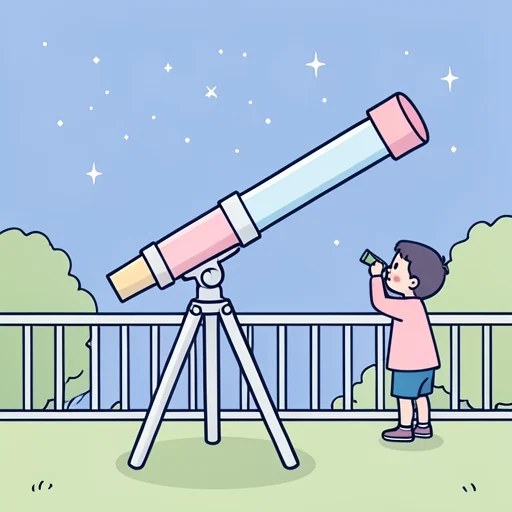
What does 望遠鏡 mean? It denotes an optical instrument that magnifies distant objects to reveal details, using lenses or mirrors to gather light and form an enlarged image for observation.
Main meanings
- the primary meaning is the optical instrument for observing distant objects
- used for astronomy (天体望遠鏡) or long-range terrestrial viewing
- metaphorical usage indicating a long-range or far-sighted perspective in text or speech
How to use it
Used across formal science education, research, media reporting, and hobbyist astronomy; in Japanese, 望遠鏡 is a general noun for devices, while 天体望遠鏡 specifies astronomical use; typical usage involves discussing observation, specifications, or the act of peering through a telescope.
Variants and close terms
- 天体望遠鏡 (tentai bouenkyou) — astronomical telescope
- スコープ (suko-pu) — scope
Composition
- 望 — gazing, to look; on'yomi bou
- 遠 — distant; on'yomi en
- 鏡 — mirror or optical element; on'yomi kyō
Etymology
望 denotes looking or gazing; 遠 denotes distance; 鏡 denotes a mirror or optical element; the compound is read with the Sino-Japanese on'yomi (bouenkyou), illustrating typical kanji-based word formation in Japanese.
Origin
The telescope arrived in Japan in the 17th century through rangaku (Dutch learning) and the spread of Western astronomy, becoming essential to science in the Meiji era.
Word class
noun (名詞)