家族
Meaning in Englishfamily
Animated kanji stroke order
Related sentences
Word context
What it means
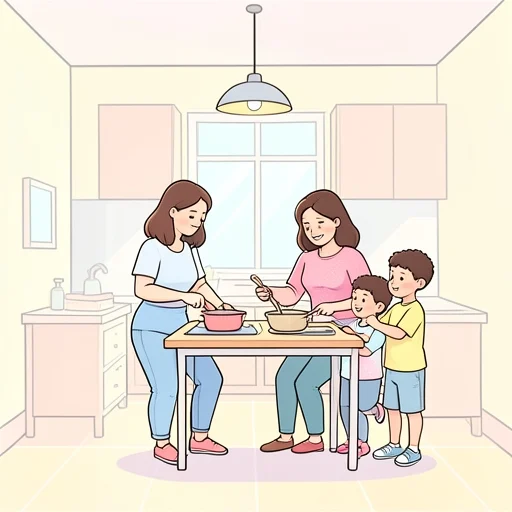
What does 家族 mean? 家族 (kazoku) means "family" and denotes the set of people tied by kinship, marriage, adoption, or those regarded as members of one's household; it conveys both the practical unit who live or share responsibilities together and the social/emotional bonds among those people.
Main meanings
- 1. The domestic household composition as a unit distinguished from individuals.
- 2. Kinship network beyond the immediate household (extended relatives) when context implies broader relations.
- 3. A collective identity or group when the element 族 (zoku) is used as a suffix to label tribes or subcultures (e.g., a group with common traits).
- 4. A target demographic in media and marketing — used to indicate family-oriented products or services.
How to use it
Used in both casual and formal speech to refer to someone's family; a polite prefix is often added when speaking about another's family. It appears in everyday questions about family size or composition, in legal and administrative contexts to indicate registered relatives, and in compounds and advertising to signal family-related themes or services.
Variants and close terms
- 家庭 (katei) — home, household
- 親族 (shinzoku) — relatives, kin
- 家 (ie) — house, home, household/lineage
- ファミリー (famirii) — family (loanword, often casual or marketing)
- 独身 (dokushin) — single, unmarried (contrast/antonym in some contexts)
Composition
- 家 (ie) — house, home, the domestic space or household.
- 族 (zoku) — clan, tribe, group sharing lineage or characteristics.
- Together the characters form a compound meaning a household group or clan, combining the idea of a dwelling/house with a lineage or group to express the concept of "family".
Origin
The social concept of family in Japan has deep roots in the premodern ie household system that organized lineage, property, and household authority; during the Meiji period and through legal changes around family registration (koseki), the modern idea of individual civil family units developed further, and postwar reforms shifted Japan toward smaller nuclear households, shaping contemporary uses of the term.
Word class
noun (名詞, meishi)