嵐
Meaning in Englishstorm, tempest
Animated kanji stroke order
Related sentences
Related sentences
There are no published items in this section yet.
Word context
What it means
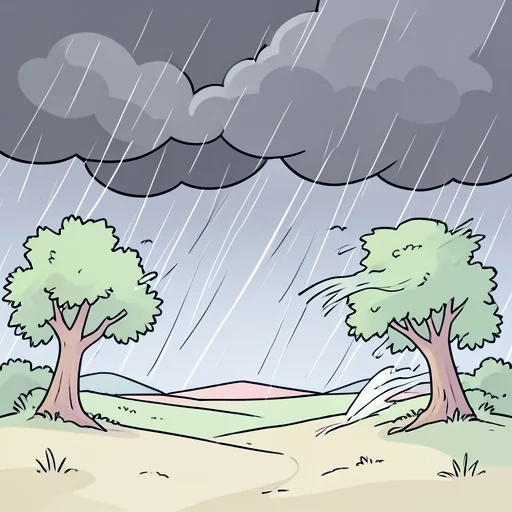
嵐 (arashi) means a powerful, often sudden meteorological storm characterized by strong winds and turbulent conditions; in everyday English usage it denotes both literal violent weather and, by extension, intense, short-lived upheaval or disturbance.
Main meanings
- Figurative upheaval: used to describe emotional, social, or political turmoil that arrives quickly and forcefully.
- Sudden commotion or flurry: a rapid burst of activity, confusion, or noise not necessarily related to weather.
- Proper-name usage: adopted as a title or name in modern contexts (e.g., groups, media), functioning as a recognizable label rather than the common noun.
How to use it
Used in weather reports, news, literature and everyday conversation to describe actual storms or to convey intense, disruptive events; appropriate in both formal and casual contexts depending on phrasing, and commonly combined with particles and verbs to indicate occurrence, approach, or aftermath; it can also appear as a name or title in creative or commercial contexts.
Variants and close terms
- 暴風 (boufuu) — gale, violent wind
- 台風 (taifuu) — typhoon (related meteorological phenomenon)
- 騒ぎ (sawagi) — commotion, uproar (near-synonym in figurative use)
- 晴れ (hare) — clear weather (antonym)
Composition
The single kanji 嵐 (arashi) functions as an ideograph representing tempestuous wind and its effects; rather than a compound of separate lexical morphemes, the character visually and semantically encodes the notion of violent weather in one unit.
Etymology
嵐 (arashi) is a native Japonic word attested in Old Japanese; its phonetic form has been preserved from classical pronunciations recorded in early poetry, and the written kanji was later applied to represent that native word rather than reflecting a foreign or borrowed origin.
Origin
The idea of violent storms has long featured in Japan's climate-dependent society and appears throughout classical literature and folk practice, where storms influenced agricultural, maritime, and religious responses and were frequently invoked in poetry and seasonal references.
Word class
noun (名詞)