想像
Meaning in Englishimagination, guess, mental creation
Animated kanji stroke order
Related sentences
Word context
What it means
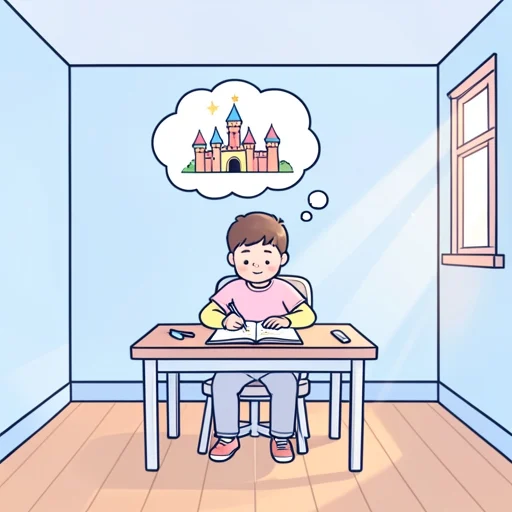
What does 想像 mean? It denotes the faculty of forming mental images or concepts and, when used with する, the act of imagining; it centers on envisioning things in the mind rather than perceiving them directly.
Main meanings
- Imagination as a mental capacity to visualize scenes, ideas, or possibilities
- The act of imagining something not real or present, including daydreams and hypothetical scenarios
- A broader sense of creative possibility or fantasy in literature and art
- Commonly used with 想像する to refer to the process or act of imagining
How to use it
In formal and casual Japanese, 想像 is used to talk about mental imagery, speculative thinking, and creative envisioning. It commonly appears with 想像する to express the act of imagining, and in academic or creative contexts to discuss hypothetical scenarios, plans, or artistic concepts.
Variants and close terms
- 幻想 gensō — fantasy, illusion
- 夢想 musō — daydream, fantasy
- 想像力 sōzō-ryoku — imaginative power
- 現実 genjitsu — reality (antonym)
- 連想 rensō — association (related concept)
Composition
- 想: to think, to consider; mental activity
- 像: image, likeness, figure; an image or representation
Etymology
Phonetic evolution 想 contributes the on'yomi sō and 像 contributes zō; together in modern Japanese they form 想像 pronounced sōzō, a Sino-Japanese compound whose pronunciation aligns with standard on’yomi readings.
Word class
noun (名詞); verb phrase 想像する (to imagine) [suru-verb]