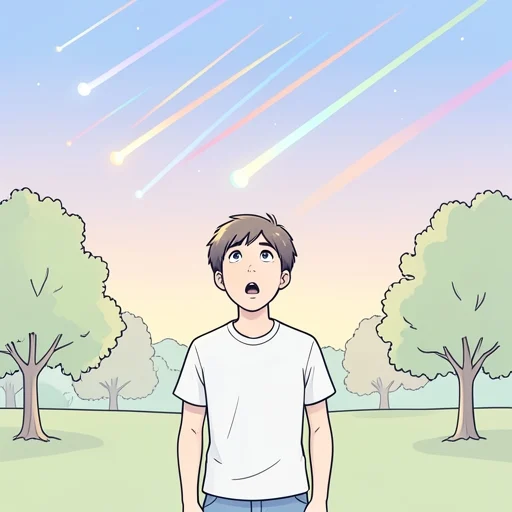
彼の顔には珍しい現象に対する驚きの色が浮かんでた
Meaning in EnglishA look of surprise at the rare phenomenon appeared on his face
Animated kanji stroke order
Word
Words found in the sentence
Kanji
Related kanji
N3
彼
hi / kare, kano, ka.no
he, that, the
N3
顔
gan / kao
face, expression, visage
N2
珍
chin / mezura.shii, takara
rare, curious, strange
N3
現
gen / arawa.reru, arawa.su, utsutsu, utsu.tsu
present, existing, actual
N2
象
shou, zou / katado.ru
elephant, pattern after, imitate
N3
対
tai, tsui / aite, kota.eru, soro.i, tsurea.i, nara.bu, muka.u
vis-a-vis, opposite, even
N1
驚
kyou / odoro.ku, odoro.kasu
wonder, be surprised, frightened
N4
色
shoku, shiki / iro
color, couleur, color
N3
浮
fu / u.ku, u.kareru, u.kabu, u.kaberu
floating, float, rise to surface
Grammar
Related grammar structures
N4
〜に対して
ni taishite
Indicates target, direction, attitude, or contrast toward something, attaches to a noun, means toward, against, or in relation to
N4
〜ので
node
Indicates cause or reason in a softer way than kara, connects two clauses, often used in polite explanations
N4
〜し
shi
Indicates multiple reasons or qualities, connects clauses or adjectives, means besides that, and also
N5
〜が
ga
Marks the grammatical subject, highlights new information, can also show slight contrast in some sentences
N5
〜に
ni
Indicates destination, target, arrival point, specific time, or person receiving an action
N5
〜で
de
Indicates where an action happens, means used, tool, cause, or material depending on context
N5
〜の
no
Indicates possession, relation between nouns, nominal explanation, or turns a verb into a noun phrase
N5
〜か
ka
Marks a question, alternative, or uncertainty, appears at the sentence end or between options
N5
〜は
wa
Marks the topic of the sentence, indicates what the sentence is about, can contrast with another element, organizes main information